MJ’s Musings: SEP-Kiss An Angel

In 2019, my Thursday Thoughts blog will feature a review of a Susan Elizabeth Phillips novel on the first Thursday of every month.

This month’s review is one of my top three favorite SEP books: KISS AN ANGEL. My paper copy disintegrated, so I purchased it on Kindle.

When I learn people who are SEP fans haven’t read this story, I am shocked. The excuse I hear most often is, “Isn’t that the circus book?” accompanied by a wrinkled nose, as in, “Eww.” Really? You would pass up an wonderful story because the backdrop is a circus? The setting isn’t merely a backdrop. It is also the device that explains a huge part of the hero’s behavior and is the driving force behind the heroine’s growth. The circus–a traveling mud show–is a character; a living, breathing entity.You accept a football universe. Why not a circus, which is more varied?

This book makes me cry every time I read it. It is a marriage of convenience story combined with on-the-road elements. DAISY is coerced into marrying  ALEX by her father, who claims his only child needs to “grow up.” That he has an ulterior motive for the match shouldn’t come as a surprise. How, you ask, can a father in a contemporary novel force his daughter to do anything? SEP has that covered.

Alex and Daisy’s individual growth toward Happily Ever After is deep and emotionally moving.

As in all of SEP’s novels, there is a secondary romance. I’m not a huge fan of many of those romances. Some feel a touch creepy-icky to me. The one in KISS AN ANGEL is borderline icky, but it suits the characters involved, and plays a major role in Daisy and Alex’s HEA.

If I were to give out stars on a 1 to 5 scale, KISS AN ANGEL would receive five.
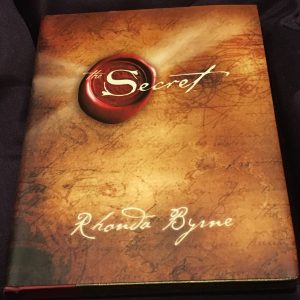
The Secret About The Secret

Several years ago, this book took the US by storm.

Someone gifted me a copy, but I have not read it.

A friend did read it, and subscribed to the theories. She explained to me how it works, which sounded a lot like Abraham and the Law of Attraction: if you believe something wholly and completely, it will come to pass.

My take?

If that were true, no babies would ever go to bed hungry.

Texture: It’s the Details

My brain has always focused on the details of a scene. The minutia. I remember the wallpaper of my bedroom when I was two. It was tan with cowboys and lassos on it. My grandmother wore my favorite apron the day my parents brought my baby sister home from the hospital: white, with blue tea kettles on it. The kitchen was yellow, and the bassinette was next to the stove.

I think putting the details into a book adds texture. The details reveal character. Susan Elizabeth Phillips is a genius at doing this. What I Did for Love is full of texture, and that’s why it’s one of my favorite books. Jennifer Crusie does it in Bite Me.  The books I go back to and re-read  all the time have the little details that appeal to me.

I need to remember to add these things in my own writing.


Female Quest Stories

Many years ago, when I first got on the Internet and was hanging out on AOL, a discussion came up about quest stories for children where the searcher was a girl. We came up with two: The Wizard of Oz and Alice in Wonderland/Through the Looking Glass.

Since that time, I’ve come up with another:  A Wrinkle in Time.

One of my writer friends says the Narnia series also has a female protagonist. I never read the books. I tried to get my children to read them, but they didn’t care for them.. If she says there was a girl protagonist, I believe her.

Can you add to this list?

#UpbeatAuthors: Self-Respect

When I become interested in an author, I will read all I can about that person. Many years ago, someone recommended A Room of One’s Own by Virginia Woolf to me. I read it. I liked it. I bought several of her books. Didn’t care for her fiction. I took out volumes of her letters from the library and read them. I purchased A Writer’s Diary, a book with excerpts from her journals as compiled by her husband after her death. There were relatable moments. One might say I studied Virginia Woolf as an author.

A friend of mine was involved in a book discussion group at a local university. When the group was scheduled to discuss Woolf’s A Room of One’s Own, my friend invited me to attend with her. We went to the college professor’s home for the discussion. I was young, impressionable, and feeling rather awed that these educated people were including me, with my high school diploma, in their discussion. We drank tea in a room with red “oriental” carpets strewn over shiny wood floors. There may have been Georgia O’Keefe prints on the white walls. I was a little intimidated.

I didn’t say much. After all, who was I?

I now regret not speaking up at the end of the session, when the professor said, “We should all strive to emulate Virginia Woolf.”

As I said to my friend in the car as we drove home, “Why would I want to emulate a woman who committed suicide? Killing myself isn’t my definition of success.”

My friend was shocked. She didn’t realize Woolf had indeed killed herself. She berated me for not speaking out. I confessed my intimidation. She replied: “But you’re right.”

After that night, I didn’t feel quite so belittled for skipping college to get on with life. Not having a degree doesn’t mean I’m ignorant. It merely means I’m self-educated.